
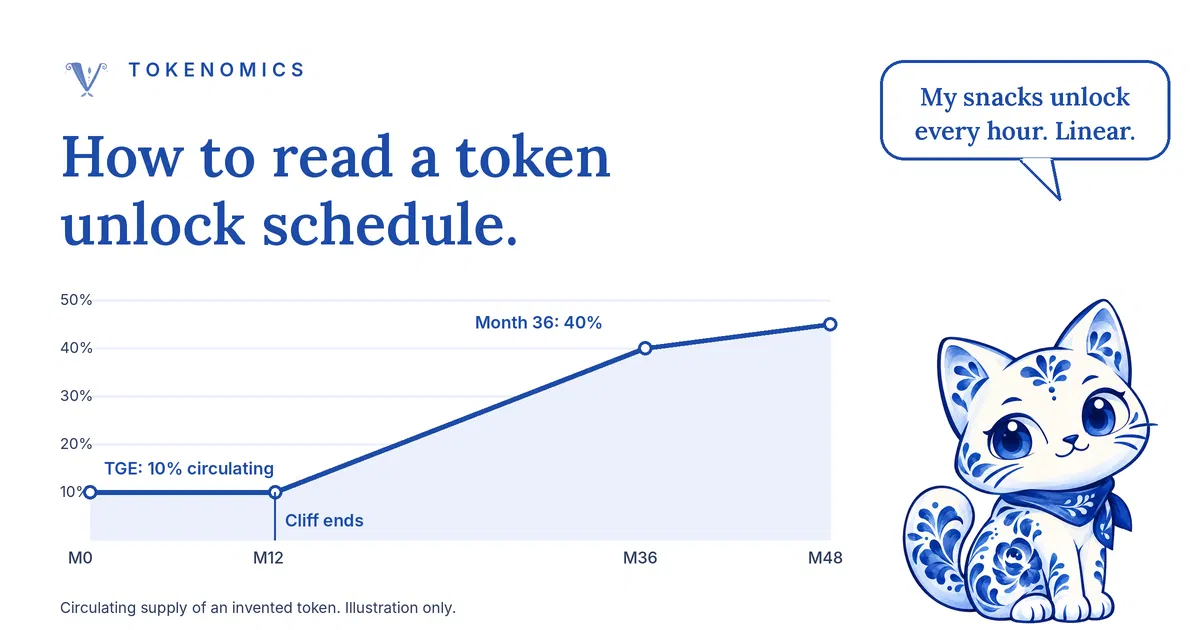
A token launches with a small part of its supply tradable and the rest locked. The unlock schedule says when the rest arrives. It is one of the first things we read in a data room, because it shows how much new supply the market will have to absorb, and when.
The numbers below are for a made-up token, used only to show the arithmetic.
The setup
- Total supply: 1,000,000,000 tokens.
- Circulating at TGE: 100,000,000, which is 10%.
- Team: 150,000,000 tokens, 12-month cliff, then linear unlock over 36 months.
- Investors: 200,000,000 tokens, 12-month cliff, then linear unlock over 24 months.
- Price at launch: $0.50.
Two numbers that look alike
Market cap is the price times the circulating supply: $0.50 x 100,000,000 = $50M. Fully diluted valuation (FDV) is the price times the total supply: $0.50 x 1,000,000,000 = $500M. The gap between them is the supply still locked. A token with a small market cap and a large FDV has a lot of unlocking ahead.
What a cliff does
A cliff is a waiting period. In our example nothing from the team or investor allocations unlocks for 12 months. After month 12, unlocks begin.
What linear unlock does
After the cliff, tokens unlock in equal steps, usually monthly.
- Team: 150,000,000 / 36 = about 4.17M tokens per month.
- Investors: 200,000,000 / 24 = about 8.33M tokens per month.
- Together: about 12.5M tokens per month, which is 1.25% of total supply.
The number that matters
Compare that monthly figure with the circulating supply at launch. 12.5M against 100M is 12.5%. From month 13, the circulating supply would grow by that much every month from these two allocations alone, before any other bucket is counted. That is the pressure a market has to absorb, and it is why the first twelve months after TGE matter so much.
Questions to ask about any schedule
- What share of supply is circulating at TGE, and who holds it?
- When does each cliff end? Do several end in the same month?
- What does the monthly unlock add, as a share of circulating supply?
- Are the dates and amounts public and on chain, or only in a document?
- Is any part tied to milestones, and who decides whether they are met?
A schedule that is easy to explain in two sentences is usually a good sign. If it takes a spreadsheet to explain, expect questions.
The token and figures above are invented for illustration. This article is general information and not financial advice.