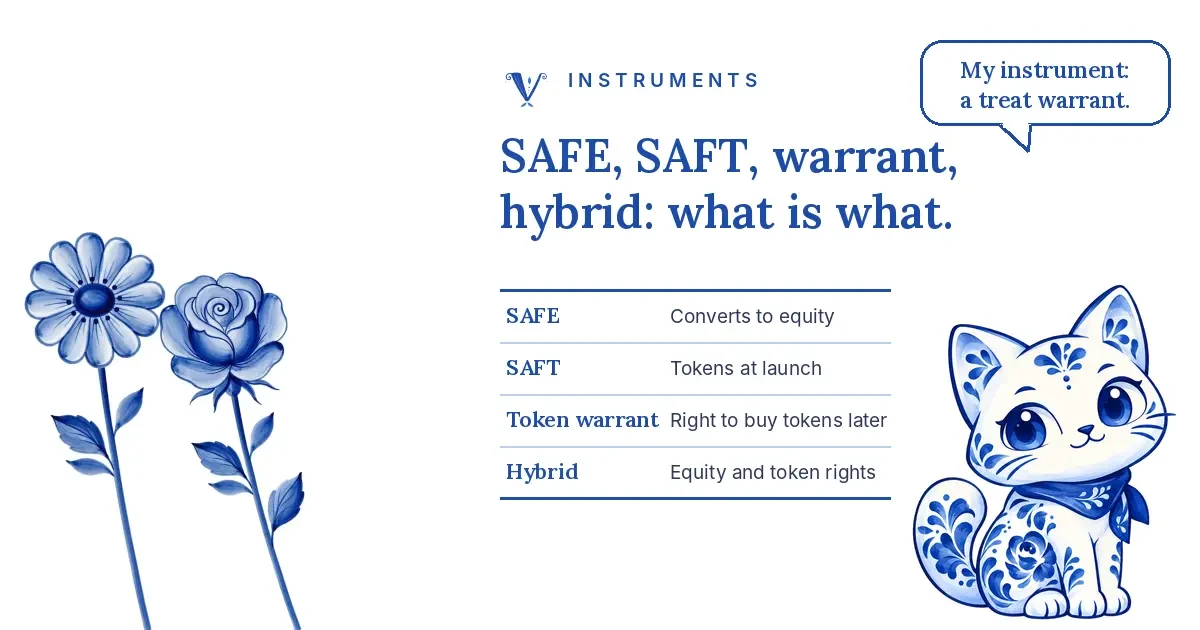
Web3 rounds use more than one kind of paper, and founders often sign one without being sure what it gives the investor. Vanneck uses four instruments: SAFE, SAFT, token warrant and hybrid. Here is what each one means in general terms. Exact rights always depend on the document, so read yours.
SAFE
A Simple Agreement for Future Equity. The investor pays now and receives equity later, usually when the company closes a priced round. Until then there is no stock. The key terms to read are the valuation cap and any discount.
SAFT
A Simple Agreement for Future Tokens. The investor pays now and receives tokens when the network launches and the tokens are issued. The key terms are the token price or valuation, the delivery conditions and the vesting of the delivered tokens.
Token warrant
A right, but not an obligation, to buy tokens at a set price in the future. The founder gets money or a commitment now, and the investor decides later whether to exercise. The key terms are the strike price, the exercise window and what happens if the token never launches.
Hybrid
A single deal that carries both equity and token rights. This fits companies where the business and the token are linked. The key question is how the two parts relate, for example whether the token rights are tied to the same valuation as the equity.
Which one fits
- A company with no token planned usually points to a SAFE.
- A project that is building a network and will issue a token points to a SAFT or a token warrant.
- A company with both a business and a token often ends up with a hybrid.
Questions to ask before you sign
- What exactly does the investor receive, and when?
- What happens if the token never launches, or the company never prices a round?
- How do vesting and lockups apply to what the investor receives?
- Is ownership calculated the same way for equity and for tokens?
At Vanneck, token allocation follows the same logic as equity: the check divided by the valuation. If a term sheet from any investor treats the two differently, ask why.
This article is general information for founders and not legal or financial advice. Ask your own lawyer to review any agreement.