
Most term sheet arguments are about valuation. Two other clauses often matter more when a company is sold or raises at a lower price. These are the versions in Vanneck's standard terms, with numbers so you can check them yourself.
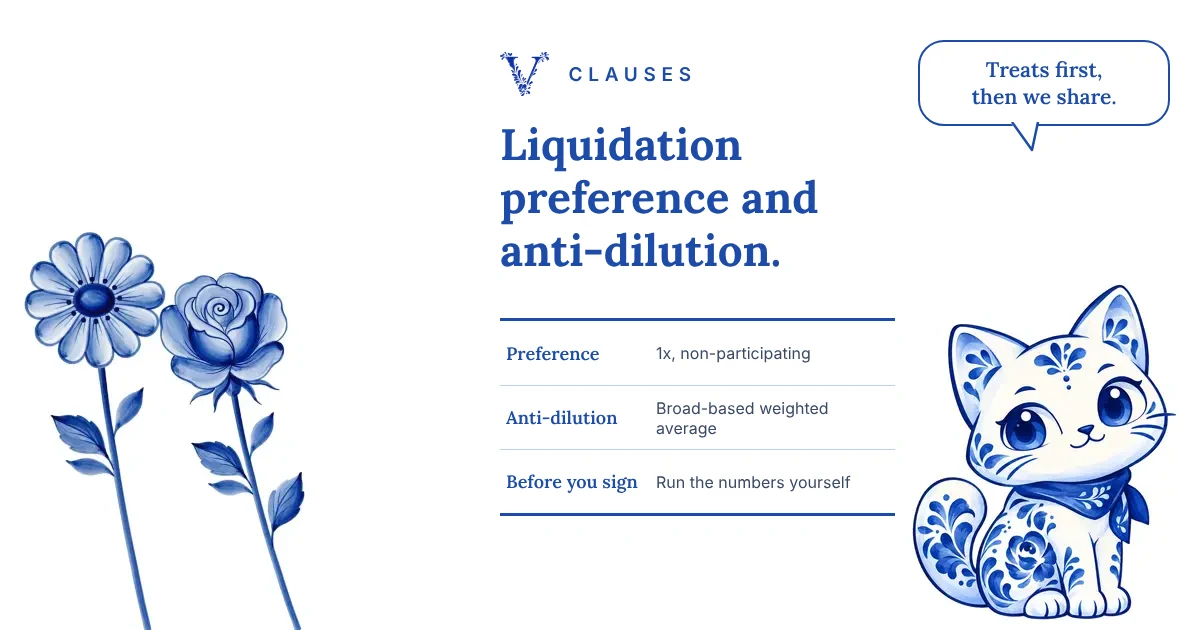
Liquidation preference: 1x, non-participating
A liquidation preference decides who is paid first when the company is sold. "1x" means the investor can take back the amount it invested before common shareholders receive anything. "Non-participating" means the investor must choose: take that money back, or convert to shares and share in the proceeds. It cannot do both.
Take a $500K investment at a $10M post-money valuation. That is 5% of the company.
- The company is sold for $6M. Five percent is $300K, which is less than $500K, so the investor takes its $500K back. The founders and others share the remaining $5.5M.
- The company is sold for $20M. Five percent is $1M, which is more than $500K, so the investor converts and receives $1M. The other $19M goes to everyone else.
The investor receives whichever amount is larger, never both. That is the difference from a participating preference, where the investor would take its money back and then also share in the rest.
Anti-dilution: broad-based weighted average
Anti-dilution protects an investor if the company later sells shares at a lower price than the investor paid. Broad-based weighted average is the milder form. It adjusts the investor's conversion price only partly, and it counts all existing shares and options in the calculation, so a small down round causes a small adjustment.
The formula is:
New price = Old price x (A + B) / (A + C)
- A is the number of shares outstanding before the new round, including options.
- B is the number of shares the new money would have bought at the old price.
- C is the number of shares actually issued in the new round.
An example. The investor paid $1.00 per share. There are 10,000,000 shares before the new round. The company then raises $1M at $0.50 per share.
- A is 10,000,000.
- C is 2,000,000, because $1M at $0.50 buys that many shares.
- B is 1,000,000, because $1M at the old price of $1.00 would have bought that many.
- New price is $1.00 x 11,000,000 / 12,000,000, which is about $0.92.
The investor's price falls from $1.00 to about $0.92, not all the way to $0.50. A harsher clause, full ratchet, would have moved it to $0.50 and shifted much more of the cost to the founders.
What to check in any term sheet
- Is the preference 1x, and is it non-participating? A higher multiple or participation changes the exit maths a lot.
- Is anti-dilution broad-based weighted average, or full ratchet?
- Does a down round trigger any other rights beyond the price adjustment?
- Run both examples above with your own numbers before you sign.
If a term sheet departs from these standard terms, ask why.
This article is general information for founders and not legal or financial advice. Ask your own lawyer to review any term sheet.